



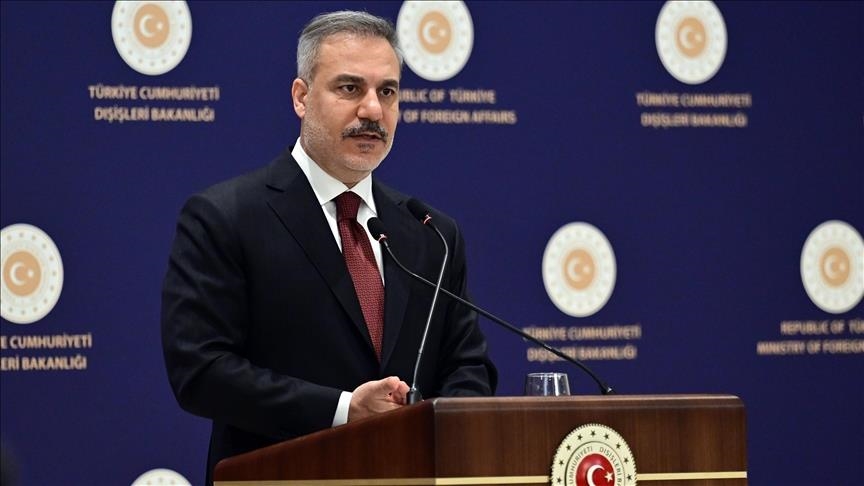
Turkish Foreign Minister Hakan Fidan issued a stern warning on Thursday against any external military intervention in Iran, urging Tehran to address its domestic challenges independently. Speaking to reporters in Istanbul, Fidan emphasized that while Iran faces internal friction, much of the unrest is rooted in economic hardship rather than a widespread desire for regime change.
Fidan noted that the “grey area” between economic grievance and ideological opposition is often misinterpreted by foreign observers. He argued that years of heavy sanctions have stifled a dynamic and sophisticated society, creating the very pressures now boiling over into the streets.
“We do not want to see any intervention here,” Fidan stated, adding that Türkiye has not yet seen a “strong preference” from US President Donald Trump for the use of ground forces. He suggested that the path forward lies in diplomacy, particularly regarding Iran’s nuclear program, to lift the structural burdens currently crushing the Iranian economy.
Beyond Iran, Fidan turned his attention to the persistent threat posed by the YPG/SDF along the Syrian border. He reiterated that Ankara does not have a problem with the Kurdish people, but rather with the presence of “terrorist organizations” operating under various aliases across four countries.
He warned that if the March 10 agreement—a pact aimed at stabilizing the region—is not implemented in good faith, the Syrian government might be forced to use military force to maintain national unity. Fidan urged all parties to move away from “buying time” and engage in genuine dialogue to prevent the fragmentation of Syria into ethnic enclaves.
The Foreign Minister also outlined Türkiye’s pivotal role in potential peace efforts for Eastern Europe. Should a peace deal be reached between Russia and Ukraine, Fidan confirmed that Turkish naval forces are slated to take command of the Black Sea.
“The Black Sea is a region that directly concerns Türkiye,” he said, explaining that while France and the UK may lead air and land components, Ankara has been entrusted with maritime security. This comes as the US shifts toward a more neutral stance, forcing European nations to reassess the long-term reality of their own security architecture.
Fidan expressed deep concern over the “second phase” of the Gaza peace plan, accusing the Netanyahu government of lacking a genuine commitment to peace. He argued that Israel’s strategic goal remains the displacement of Palestinians from Gaza, a move Türkiye and the international community continue to resist.
He confirmed that a Palestinian Technical Committee is expected to begin governing the territory within weeks, followed by the establishment of a Peace Council. “The suffering of Palestinians… deeply wounds our collective conscience,” Fidan said, highlighting President Erdogan’s focus on delivering humanitarian aid.
On the diplomatic front with Washington, Fidan expressed optimism regarding the F-35 fighter jet program and the lifting of CAATSA sanctions. He noted that a “political will” now exists between President Erdogan and President Trump to clear these hurdles.
The goal remains a total removal of sanctions to reset bilateral relations. Fidan concluded by reaffirming Türkiye’s rejection of any “encirclement attempts” in the Eastern Mediterranean, vowing that Ankara would proactively defend its national interests and regional stability through 2026.

