



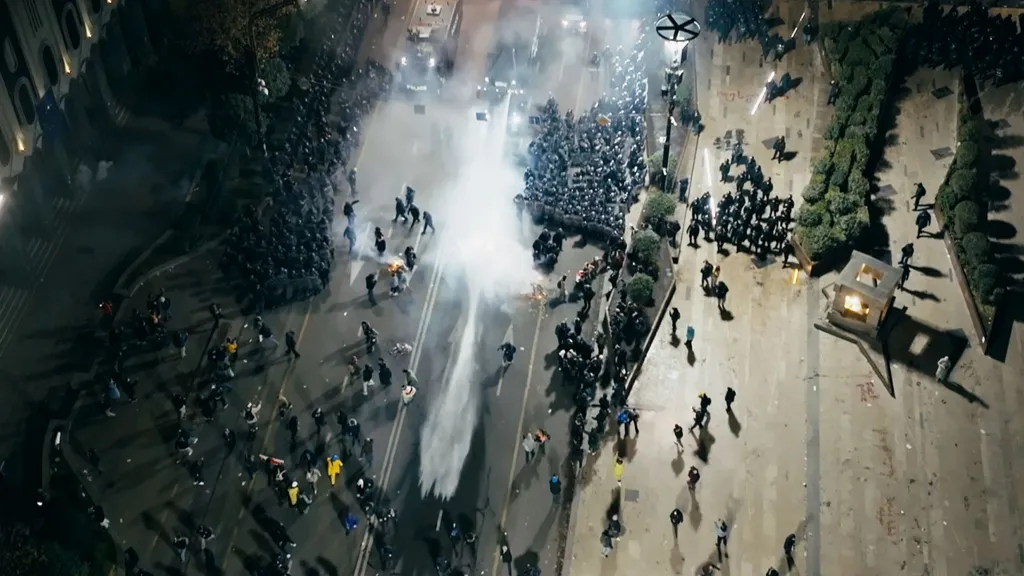
Georgian authorities are suspected of deploying a chemical compound developed during World War One against anti-government demonstrators last year in the capital, Tbilisi, according to evidence uncovered by a BBC investigation. Protesters who were targeted by water cannon have reported severe and long-lasting symptoms, pointing to the use of an agent far more potent than standard riot control gas.
One demonstrator described the experience after being hit by the water. “You could feel [the water] burning,” he said, noting the sensation could not be washed off immediately. Numerous complaints from protesters have included persistent symptoms such as shortness of breath, sustained coughing, and bouts of vomiting that endured for several weeks.
The BBC World Service spoke with chemical weapons specialists, medical professionals, and whistleblowers from the Georgian riot police. Their collective findings suggest the compound used was bromobenzyl cyanide, an agent the French military historically referred to as “camite.”
Camite was used by the Allies against Germany in the First World War but was largely taken out of circulation by the 1930s due to concerns over its persistent and severe effects. It was later replaced by less toxic alternatives like CS tear gas.
The protests began in late November 2024 after the ruling party, Georgian Dream, announced it would pause accession talks with the European Union—a goal enshrined in the nation’s constitution.
Dr. Konstantine Chakhunashvili, a paediatrician who was also sprayed by the water cannon during the protests, noted his skin felt like it was burning for days, with the irritation worsening when he tried to wash it off.
Motivated by his experience, Dr. Chakhunashvili launched a social media survey for others affected. Nearly 350 people responded, and almost half reported suffering one or more side-effects for over 30 days. These long-term ailments included fatigue, chronic coughs, and cardiac abnormalities—a finding later accepted for publication by the peer-reviewed journal, Toxicology Reports.
Dr. Chakhunashvili’s findings echo conclusions reached by local journalists and civil rights organizations, all of whom had previously urged the Ministry of Internal Affairs to identify the chemical used, a request the Ministry had refused.
Several high-level whistleblowers from Georgia’s riot police, officially the Special Tasks Department, helped identify the compound. Lasha Shergelashvili, a former head of weaponry, believes it is the same substance he was asked to test in 2009.
Mr. Shergelashvili described the test product as “probably 10 times” stronger than conventional tear gas. “We noticed that the effect was not wearing off,” he recalled, noting that the contamination on the ground was so severe that an area would be inhabitable for up to three days, even after washing. He recommended against its use, yet vehicles were allegedly loaded with it until he quit in 2022.
The BBC later obtained a 2019 inventory from the department listing two unnamed chemicals: “Chemical liquid UN1710” (identified as trichloroethylene, a solvent) and “Chemical powder UN3439.” Experts confirmed that the only riot-control agent listed under the highly generic UN3439 code is bromobenzyl cyanide, or camite.
Professor Christopher Holstege, a global expert in toxicology and chemical weapons, assessed the evidence, concluding that the clinical findings and persistent effects reported by victims are “consistent with bromobenzyl cyanide.” He explicitly ruled out CS gas as the cause.
Under international law, chemical agents used for crowd control must be proportionate and have only short-term effects. Experts consulted by the BBC suggest that deploying an obsolete and more potent compound like camite could be classed as a chemical weapon.
Alice Edwards, the UN Special Rapporteur on Torture, stressed that populations “should never be subjected to experiments.” She stated that the described long-term symptoms “are beyond what would be considered temporary and acceptable” and called for the cases to be investigated, potentially “under the rubric of torture or other ill-treatment.”
Georgia’s authorities dismissed the BBC’s findings as “deeply frivolous” and “absurd.” They insisted that law enforcement personnel acted “within the bounds of the law and constitution” in response to the “illegal actions of brutal criminals.”

