



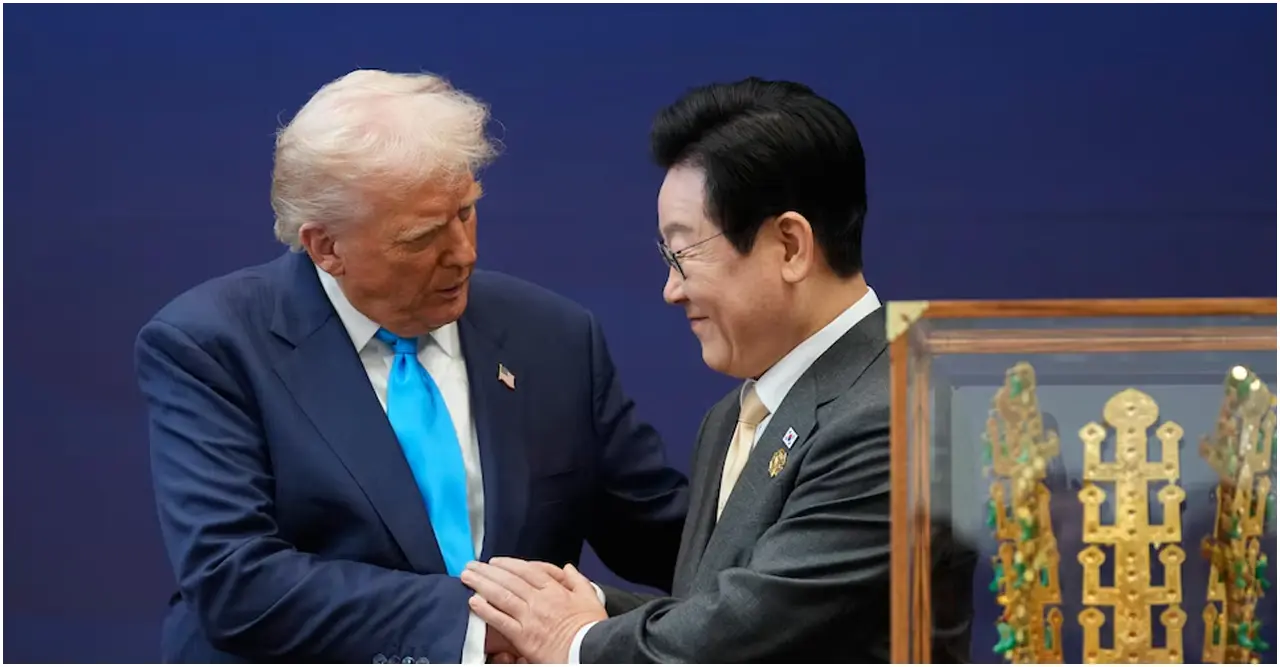
The United States and South Korea made significant progress on a large-scale trade and investment framework during President Donald Trump’s visit to Seoul on Wednesday, according to officials from both nations.
The diplomatic engagement, which included elaborate ceremonies and a state dinner hosted by South Korean President Lee Jae Myung, occurred just before President Trump is scheduled to meet with China’s President Xi Jinping.
While the president’s visit focused on strengthening economic ties abroad, his administration faced deepening political and economic crises at home, including a protracted government shutdown and new congressional scrutiny of his military policies.
In Seoul, talks centered on a framework that would see South Korea invest an estimated $350 billion into the American economy. According to Kim Yong-beom, President Lee’s chief of staff for policy, the framework includes gradual investments, cooperation on shipbuilding, and the lowering of U.S. tariffs on South Korean automobile exports.
President Trump told reporters that the deal was “pretty much finalized,” signaling a positive outcome from the negotiations. However, officials have cautioned that a formal agreement has not yet been signed. During the visit, President Lee presented Mr. Trump with a gold medal and a ceremonial crown.
As diplomacy unfolded in Asia, the federal government shutdown entered its 28th day in Washington, placing severe strain on federal employees and vital public services. Air traffic controllers were among those who missed their paychecks on Tuesday, raising fears of flight delays as officials report an increase in stress-related sick calls.
The shutdown’s impact on food security has become a critical concern. Federal funding for the Supplemental Nutrition Assistance Program (SNAP) is expected to be exhausted by Saturday. In response, a coalition of Democratic state officials filed a lawsuit on Tuesday seeking to unlock emergency funding to help tens of millions of Americans.
The impending loss of benefits has prompted several tribal nations to declare a state of emergency. The Blackfeet Nation in Montana called the situation a “crisis” in its declaration. Lonna Jackson-Street, Chairwoman of the Spirit Lake Nation in North Dakota, emphasized the severity of the situation, stating, “If our kids can’t eat, then we’re all in crisis.”
In separate developments, the administration’s military actions are drawing concern from both sides of the political aisle in Congress.
Defense Secretary Pete Hegesth announced Tuesday that U.S. forces had killed 14 people in strikes against four alleged drug-running boats in the eastern Pacific. The strikes, which occurred Monday, represent a marked escalation in the pace of such attacks in South American waters.
At the same time, top congressional Republicans overseeing the military spoke out against a new U.S. troop posture. Senator Roger Wicker and Representative Mike Rogers, who chair their respective armed services committees, issued a joint statement “strongly opposing” the administration’s decision not to replace U.S. troops rotating out of Romania.
The Republican lawmakers warned that the move “sends the wrong signal to Russia.” Their concerns were echoed by Senator Jack Reed, the top Democrat on the Senate Armed Services Committee.
In a speech on the Senate floor, Reed stated that President Trump’s “rare moves to enmesh the military with politics” are “endangering how Americans see U.S. troops” and eroding vital public trust.

