



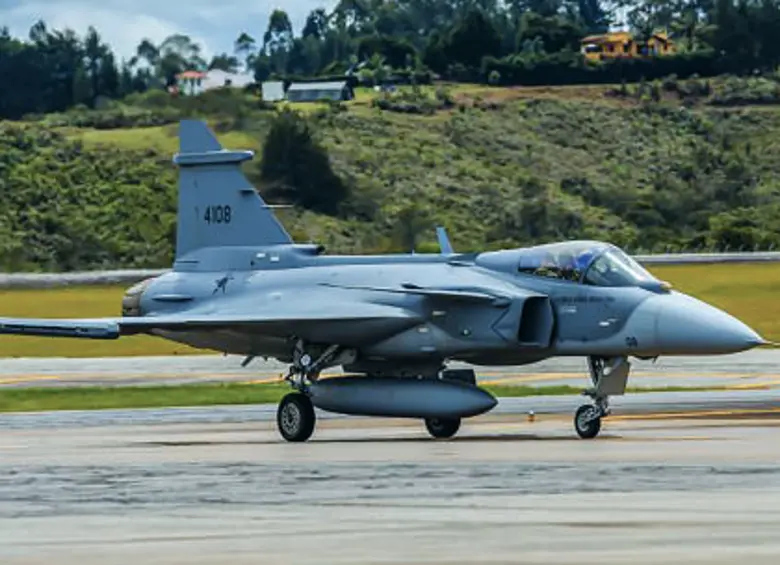
The Colombian government’s decision to purchase 17 Gripen fighter jets from the Swedish firm Saab has ignited a controversy over a potential cost overrun and the political proximity between President Gustavo Petro’s administration and Sweden. The deal, initially estimated at approximately $10 trillion pesos in 2022, was finalized for $16.5 trillion pesos (equivalent to about €3.77 billion or $3.5 billion USD at the time of the contract signing).
The total investment of $16.5 trillion pesos, as stated by the National Government, covers not only the 17 aircraft but also their associated armaments, software, radars, a simulation and training center, spare parts, and training for pilots and technicians.
President Petro clarified that the base contract was for $13.7 trillion pesos (€3.135 billion). The final $16.5 trillion figure includes macroeconomic projections and variations in the Euro-to-Peso exchange rate, as the payment is structured through future budget allocations (vigencias futuras) until 2032. The contract includes a three-year grace period, meaning the Petro administration will not make the initial annual payments, pushing the financial responsibility onto the next government starting in 2028.
The acquisition is intended to replace Colombia’s aging fleet of Israeli-made Kfir jets, which date back to the 1980s. Between 2011 and 2025, the Ministry of Defence analyzed competing offers, including the US F-16, the French Rafale, the European Eurofighter Typhoon, and the Chinese J-10CE.
Initial expert opinion suggested the Saab Gripen was technically the least powerful option compared to the others, noting its armament, flight power, technology, and the fact that it has never been tested in real combat. However, the government ultimately selected the Swedish offer based on several key factors detailed in a Defence Ministry document.
The selection was justified by the Gripen’s cheaper operating costs—at $8,500 per flight hour compared to $28,000 for the Rafale and $12,000 for the F-16—and its lower initial investment cost per aircraft. Analysts also highlighted the Gripen’s ability to take off and land on short, unprepared runways (500 to 800 meters), allowing for operations across the entire national territory. Furthermore, the aircraft features an open-architecture design that facilitates easy and rapid software updates, allowing for swift combat adaptation.
The financing advantage—the three-year grace period—was a critical factor that competitors like the US and France could not match. The US offer of repowered, second-hand F-16s also came with flight restrictions imposed by Washington, which requires itinerary sharing and restricts the use of US-supplied arsenal in certain areas, an issue that has previously affected the Chilean Air Force.
A third, unacknowledged factor was political: the relationship between the Petro government and Washington has been strained. Opponents argue that awarding a massive contract to a US-allied nation would be complicated by US accusations against the President and the existence of the Clinton List, which could block commercial agreements.
This political tension introduces a supply chain risk, as the Gripen jets are powered by US-made General Electric F414G engines. Opposition candidate Abelardo de La Espriella has formally called on the White House to impose a temporary veto on the purchase until the next Colombian government reviews the deal in 2026, citing concerns over potential corruption and the influence of the contract on upcoming elections.
The contract’s increased value has been a central point of contention. Unofficial sources indicated that Saab’s initial 2022 unit offer was approximately $150 million USD, including technology transfer and training. The price allegedly increased as additional features and equipment were incorporated.
In 2022, Saab CEO Micael Johansson publicly stated that the company could offer $10 trillion pesos for a highly competent fleet, questioning why the government would consider the French Rafale, which he implied was the more expensive option at the time. The final contract price of $16.5 trillion pesos significantly exceeded this initial projection.
President Petro defended the final price by stating that the aircraft were delivered with “maximum capacities,” including an advanced simulation center with four cabins, weaponry, sensor integration, maintenance tools, and comprehensive training.
A significant element that bolstered Saab’s proposal was the inclusion of socio-economic development programs. These benefits, promised by the Swedish firm, include the construction of the region’s first solar panel production plant, clean water plants for the La Guajira region, the partial construction and outfitting of the San Juan de Dios hospital in Bogotá, and a new technology innovation center.
The timing of the contract signing, amidst an “historic fiscal deficit”—projected at 7.5% of GDP in 2025 by Fedesarrollo—and close to the end of the current administration’s term, has drawn heavy criticism. The necessity of the purchase is not disputed, as the fleet replacement plan dates back to 2011, but previous governments deferred the decision due to political costs.
Defense Minister General (r) Pedro Sánchez affirmed that the payment for the bulk of the contract will begin in 2027 via future budget allocations, with the first aircraft expected to arrive between late 2027 and early 2028.
Furthermore, the negotiation has resurrected prior, unproven corruption allegations against Saab in other countries. The firm was investigated in South Africa over alleged bribes paid to lobbyists for securing a Gripen contract in the late 1990s. In Brazil, where Saab won a $4.5 billion fighter deal in 2013, the contract was investigated during the broader Petrobras corruption scandal, though the case was ultimately archived in 2019. The US Department of State, however, maintains an active file under the Foreign Corrupt Practices Act (FCPA), investigating the alleged transfer of $2 million USD to the account of a son of former Brazilian President Lula da Silva in connection with the deal.

